
Full container reports, checked before they reach you
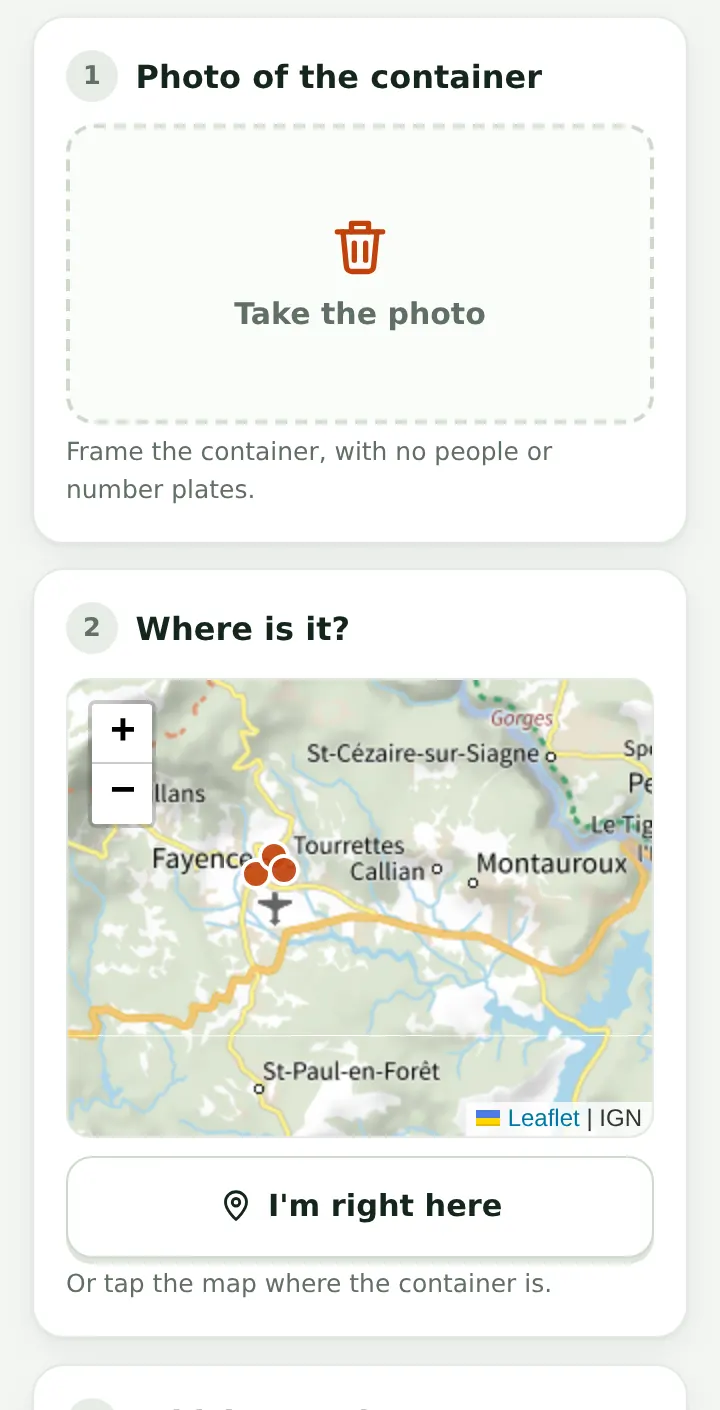
Photo, location and the checks specific to the container type: your teams go out for a real overflow, and you finally know where and when containers overflow.
The problem
A jammed box is not a full bin
A bank that looks full is often only full at the opening: an unfolded box across it, a bottle stuck in the hole. To our knowledge, no public study measures the share of these false full bins; checked reports provide the first measurement.
Fitting banks with fill-level sensors costs, according to published prices, around €110 to €130 per sensor, plus a monthly subscription. Resident reporting needs no hardware.
Step by step
How it works
- The resident signs in (a free account, once: they will know when the container is emptied).
- They take the photo, tap the location or “I'm right here”, choose the container type.
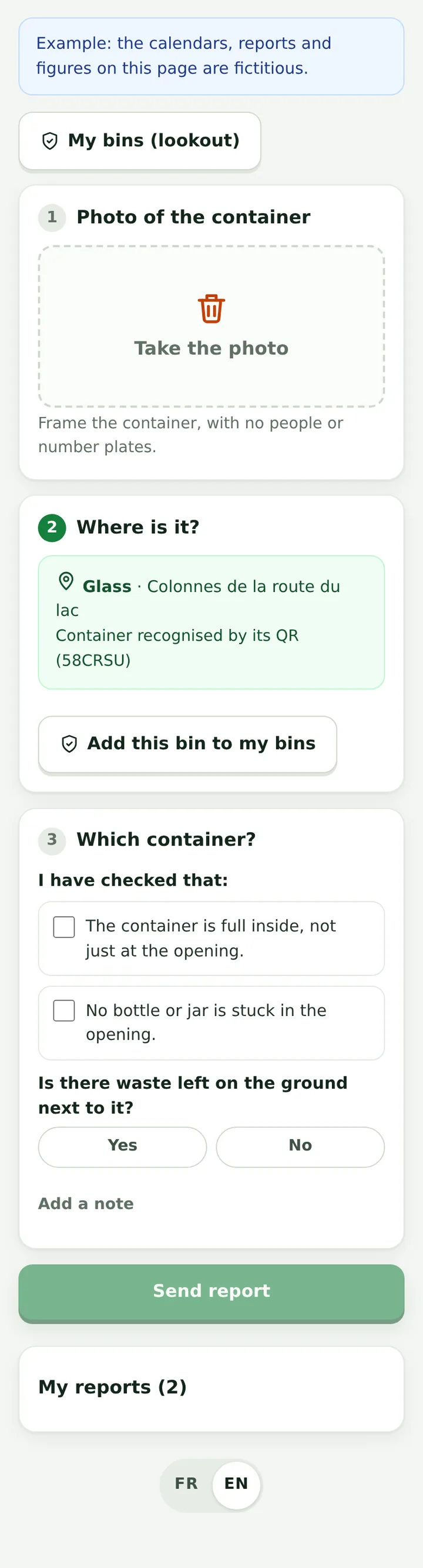
- They tick each check, for example “No unfolded box is blocking the opening”. Without every box ticked, the report is refused, with the reason.
- Another resident reporting the same container within 24 hours confirms it instead of opening a second report.
- You answer “collection planned”, “emptied” or “unfounded” (with a reason, shown to the resident).
The rules
A service, never a control
Nothing is asked about neighbours and no one is named. The question “is there waste on the ground?” is there to send the right team. The exact position and the photo are seen only by the local authority.
The “containers that overflow most” measurement groups, by container, day and type, the reports confirmed or emptied, never the “unfounded” ones: enough to adjust a round or move a drop-off point.
Frequently asked questions
Your questions
Why is an account required?
Does it replace the phone?
Access offered, on your own area
Request access for your local authority
- Open the access page and enter your work email address: it is checked against the official directory of the French administration.
- Enter the code you receive by email: you go straight into your institution's own space, locked to its area.
- Open the waste service there: your municipalities and the tools in service are already set; your recycling centres, the drop-off points mapped on OpenStreetMap and your profile follow shortly, taken from public data. Nothing fictitious: it is your area.
- Each colleague signs in with their own address and joins the same space. Each address is valid for one month; access ends by itself.
Reserved for French public bodies: municipalities, inter-municipal bodies, waste syndicates, departments, regions, public establishments, State services. The access pages and the tool's settings screens are in French. Address not recognised? Write to us.
Demo
Or see the demo first
See right away, without asking for anything, what residents see: the Recyclerie (giveaways), collection days, full bins, the map, shredding. The content is an example, labelled as such on every screen.
For the local authority side (dashboards, settings, article 58 return), sign in with your work email: a code is sent to you and you land directly in the waste service.